Showing posts with label art. Show all posts

Saturday, December 5, 2015

Dear Uke, You are the Ink!

Taking Ukemi - You are the Ink
by Suzane Van Amburgh

Do you take ukemi the same way on a person's kyu test that you do in regular class?

When a person tests, he or she is performing specific forms as clearly as that candidate can. The test is a time to demonstrate one's understanding and embodiment of the principles of aikido. As uke, your job is to reflect clearly what the practitioner is demonstrating.

The format of the kyu test usually requires the candidate to perform certain classic techniques in their most basic and fundamental form. We have a clear, published curriculum; the Birankai North America kyu guidelines. A 5th kyu test includes a specific list of techniques to perform. As the student progresses more complexity and knowledge of variations is expected. However, in the lower kyu ranks we set a pretty clear expectation of exactly what techniques they can expect to have to perform.

As uke, on a person's test, your job is to move with them wherever they go. It's not about you; it's not about what you think is right or correct. This is not a time to lead them or "help" them. Launch a clear and accurate attack and then your body should provide a clear reflection of their movement (to the best of your ability).


Nage is an artist, wielding a brush. You are the ink stuck to the end of that brush. Wherever your foot falls on the mat, wherever your body makes contact with the mat, is the resulting art; the calligraphy or the lines and splotches reflecting that artist's intention and technique.


If the artist hesitates, will the witnesses see that hesitation in the wobble of your back foot? How clearly can you follow their movement while still taking care of yourself in the motion? The term ukemi comes from the verb ukeru; to receive or accept. Accept your partner's movement.

If your nage does something unexpected, will you be there - all parts ready and willing to go in the direction they take you? This is the best service you can provide to your fellow dojo member and to the teachers watching the test.

Try out the same approach in regular class. We practice in many ways and we provide different kinds of "nutrition" to our practice partners. However, ask yourself, as you accept their technique, are you the ink?


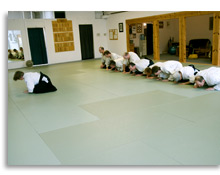
Sunday, October 5, 2014

Venture a taste! Bringing on a first course of Aikido practice this month!

Aikido First Course starts Saturday October 11


Serving up your First Course 
in the art and practice of Aikido. 
12 sessions, Sat. mornings and Tue. evenings  
Oct 11- Nov. 22.  Fee $90
  
This series is a progressive beginners' course. Plan to begin on Saturday Oct 11. Arrive 9:45 for registration. Class starts at 10 am with Orientation to Practice and segues to aikido fundamentals class 10:30-11:30am.

Class times:
Tuesday 5:30-6pm: Orientation to Practice
Tuesday 6:15pm-7:15pm: Aikido Fundamentals
Saturday 10-10:3am: Orientation to Practice
Saturday 10:30-11:30am: Aikido Fundamentals
 

 Note: Sat. Oct. 25 join us for an optional field trip to Eugene for a seminar with Phil Vargas Sensei. Click for details. There is no fee to observe seminar classes.

Tue/Sat schedule doesn't work for you?
Become a Regular Member and practice Mon, Wed or Fri at 6:15pm. As a member you can flex your schedule and come to any unrestricted class on the weekly schedule. Click to view schedule.


Drop in for Orientation to Practice It's FREE in October

Join us for The Lines of Engagement Noon, Oct 11, $10.


Thursday, September 18, 2014

Fall Aikido Schedule begins September 17

This Fall our adult aikido class schedule shifts focus. You'll see the same basic time slots through the week but the focus of those classes shifts.

Our beginners series, Aikido First Course, begins October 11 and runs Tuesdays and Saturdays through November 22.

Get a taste at the Aikido Appetizer on Saturday October 4th at 10am.

Visitors are welcome to step onto the mat and join us for the half-hour Orientation to Practice, Tuesdays at 5:30pm or Saturdays at 10am (through October 28). After, we invite you to stay and observe the fundamentals class.

The public is also welcome to join us for the Lines of Engagement on second Saturdays at noon, Oct 11, Nov. 8 and Dec. 13. The fee is $10.

Monday, Wednesday and Friday 6:15pm classes are core classes for members of all levels and focus on our monthly teaching theme.  Become a regular member and train in any of these classes.

Two classes on the schedule are restricted to members ranked 5th kyu and above: Tuesdays 7:30pm and Thursdays 6:15pm.

Advanced class is held once a month on the first Tuesday in the 7:30pm time slot.


Friday, July 4, 2014

Sandan as a Weapon


Sandan as a Weapon
by Sean Sheedy, 3rd dan, Multnomah Aikikai

In his letter to the dojo after our most recent set of dan promotions, Fleshler Sensei referred to the metaphor of the student as a sword:  at shodan a block of metal; at nidan a sharpened piece of steel; and at sandan a polished, integrated weapon.  As a new sandan, what does it mean to “be a weapon”?

A dictionary definition is perhaps a place to start.  The Oxford English Dictionary defines “weapon” as:

1. A thing designed or used for inflicting bodily harm or physical damage.
2. A means of gaining an advantage or defending oneself in a conflict or contest.

As an aikidoka seeking to reduce conflict rather than increase it, the first meaning seems problematic.  Although aikido is certainly capable of resulting in bodily harm to an uke unprepared for absorbing and dissipating the power of the techniques, inflicting bodily harm or damage is not a goal of our art.  The second meaning appears more promising, as defending oneself in a conflict by diffusing that conflict is a goal.  One thread that is common to both meanings, however, is that of intent:  in both definitions a weapon is a means of projecting one's intent into a situation of conflict.

In this sense a weapon is a specific form of tool.  Just as a chisel can be used to project one's intent onto a piece of wood, thereby transforming that wood, a weapon can be used to project one's intent into a conflict, thereby transforming that conflict.  The type of transformation actually achieved depends on both the intent of the wielder of the tool and his skill level.  A piece of wood can be transformed into a beautiful carving with proper intent and skill with a chisel.  Conversely, a different intent or the lack of sufficient skill to produce a carving can result in wood chunks only suitable for firewood.  Similarly, a conflict can be transformed into peace with both the intent of diffusing the conflict and skill with a weapon.  Lacking peaceful intent or sufficient skill can result in more conflict and damage.

One consequence of this observation is that a weapon, like a chisel, has no intrinsic morality.  Rather, the morality is derived from the intent of the tool wielder being transmitted through the otherwise inert tool.  Seneca the Younger relayed a similar observation some 2000 years ago:

Quemadmodum gladius neminem occidit: occidentis telum est.
A sword by itself does not slay; it is merely the weapon used by the slayer.

Though necessary, proper or moral intent is not sufficient to successfully project one's will to transform.  Skill acquired through study and regular practice is also required or the result can be indistinguishable from that of bad intent.  This requirement for a constant refining and honing applies to the tool itself as well as the user of the tool.  Chisels and swords must be actually handled to develop the skill of their use, but doing so causes them to nick and dull, and eventually requires them to be sharpened.  Even when sitting unused, chisels and swords must be cleaned and oiled or they may rust and not be ready when required.  Similarly, even if not engaged in their art the artisan and warrior must maintain their basic physical and mental conditioning or risk not being ready to apply their tools when required.  The tool and the tool user are thus inseparably intertwined:  both must continue to develop together in an endless cycle or forfeit the ability to successfully transform their surroundings.

This fundamental inseparability between tool and tool-user is what it means as a martial artist to “be a weapon”.  If I as an aikidoka am a weapon, I am both the intentional agent and the tool to achieve a transformation from conflict to non-conflict.  If I am a weapon, I must consciously and consistently develop my skills, renew my sharpness, and avoid deterioration due to inattention; failure to do so risks producing firewood instead of a carving.

Nonviolence is a powerful and just weapon which cuts without wounding and ennobles the man who wields it.  It is a sword that heals. 
 -- Martin Luther King, Jr.

Sunday, May 11, 2014

On the occasion of new dan grades - A Fleshler, 6-dan, Shihan, Birankai North America


On the Occasion of New Dan Grades
May 9, 2014

A Fleshler, 6-dan, Shihan, Birankai North America
Technical Director, Multnomah Aikikai
Portland, Oregon

It has been some years since we’ve had new shodan in our dojo. There is so much expectation and emotion associated with these promotions. They certainly are a marker of some kind in each student’s life, and in the life of the dojo. But what kind of marker?

Very often a new shodan (or nidan, or sandan) feels a mixture of pride and shame: “It’s over, I did it, but I am also completely exposed in my ignorance and incompetence.” In my view, this is completely appropriate. This is a realistic expression of one’s humility, and appreciation of the unending character of the road ahead. One should get used to not knowing, no matter how much you train. This is shoshin, beginner’s mind, the foundation of carrying oneself as a warrior.

You may have heard the metaphor of the student as a sword: at shodan, a block of metal, forged for resilience and strength; at nidan, a sharp sword, with a clear edge for cutting; at sandan, a polished, integrated weapon. The process continues for the rest of life, for the rest of training, of course.

Another metaphor: at first, the training reaches only the skin; then the muscles; then the bone; then the marrow; then a slender line of energy through the center of the bones. Again, a suggestion of a very long process, one which cannot be hurried.

Both metaphors speak to deepening integration and increasing naturalness of movement, of interaction, of perception. However, this is literally a superficial understanding, because it separates the body from the mind and spirit. What is required is the penetration of the art into one’s character, personality, and approach to life in all its challenge and complexity. Think of the Five Pillars expressed by Chiba Sensei: Centered, Whole, Open, Connected, Lively. Do you think he is talking only about the technical practice we study in our classes? Do you think you can continue to strengthen these Five Pillars in the dojo without challenging yourself to grow outside the dojo?

The end stage as described by O’Sensei is something called “Take Musu Aiki”. For now, let’s just say this means a completely natural, spontaneous, and appropriate manifestation of the art, with no imposition of will and ego, with no detachment and escaping from the reality which presents itself — so much so that the violence of a confrontation dissipates without any effort, and without any winning or losing.

O Sensei also spoke of “Standing on the Rainbow Bridge”. Simply put, your insides are connected to your outsides; the source of your being is completely connected to your manifestation. (This is a piece of a his very elaborate spirituality, but we can extract this jewel for our purpose here.)

In the face of such a vision, in the face of such a challenging road, humility is a completely appropriate emotion. There is an old Zen expression: “Before Enlightenment: Chop Wood, Carry Water; After Enlightenment: Chop Wood, Carry Water.”  Let’s begin again.

Gassho,
==AF


Monday, May 5, 2014

New format for testing and rank promotion deemed sucessful

They say necessity is the mother of invention. As our dojo approached the time for students to test, it became clear that a single night testing format was not going to serve the membership.

We had people, ripe for promotion, who were practicing with injuries.  The teachers and teacher candidates who needed to observe testing had divergent work schedules. We were scarce on available ukes. We had potential rank promotions ranging from 5th kyu to yudansha. One night just wasn't going to work.

I've seen other martial arts schools implement a testing period of several days. Candidates are observed over a period of time and promotions may or may not come out at the end of the period. I haven't seen that format employed in aikido dojos. Of course as teachers we watch students over time and the testing night is a culmination of a longer period of test preparation. You can't "cram" for an aikido test! However, I've always seen aikido dojo testing conducted in one session; usually in the course of one evening.

At our dojo I proposed we hold a multiple evening, all-dojo evaluation and testing event. Teachers and teacher candidates discussed schedule and we agreed upon three consecutive nights. Students preparing for tests agreed to clear their schedules and come all three nights. Middle and younger ranks came to the days that they could.

Over the three nights, a large percentage of the Birankai curriculum was called. A mix of standing, sitting and hanmi handachi techniques were covered each night as well as weapons forms. Candidates had a chance to serve as both uke and nage. If a fundamental form was performed weakly on one night, there was a chance to do better in the next night.  When one candidate surpassed expectations, I had the chance to raise the bar on the following night and give him a chance to perform at a level above the rank he was testing for.


As the three nights came to conclusion we clearly had come through the fire together as a group. Tension had dropped, shoulders had melted and we announced 6 new promotions.* Individuals not testing for specific rank were offered a challenge  and invitation to prepare for the next testing opportunity. Teachers and teaching candidates had the opportunity to evaluate where we are as a dojo and what material the members need to study in regular weekly classes.

Listening to students after the event, it was clear that this format was a good experiment. One member mentioned it felt like the end of summer camp; no tension left. Just continuous movement, washed in sweat, revolving around and within ones center.


photo provided by Terese Scollard

*Promoted April 3, 2014

Sandan: Sean Sheedy, Jon Paul Oliva


Shodan: Kevin Greenwood, Sanders Anderson


Nikyu: James Murray


Gokyu: Troy Wilson


Article written by by Suzane Van Amburgh


Contact us: dojo@multnomahaikikai.com
Aikido Multnomah Aikikai 503-246-8120


Sunday, February 9, 2014

Aikido! What's it like? Watch a class


Observing Aikido Class

What are you watching?

No class is “typical.” We encourage you to watch several. Techniques can be applied slowly and gently or quickly and powerfully. We practice a variety of movement qualities.

Warm up period

Class generally begins with “warm ups” which may last 10-20 minutes. In our dojo this may include a combination of stretching, breathing, sensory motor coordination exercises, conditioning and traditional centering techniques. Why do we do it? Warm ups prepare us for the activity we are about to engage in physically and mentally. Each day we are different. Warm up period brings us present with our bodies and minds and orients us toward awareness in the present moment. Physically, this minimizes risk of injury. Mentally, awareness of self in its present state is paramount to engaging appropriately with another person.

Technique time

The traditional format of class is for an instructor demonstration followed by partner practice. The instructor may veer from traditional format from time to time in order to keep practice fresh and attention sharp. There are many aspects of training to explore and the instructor may draw the students’ attention to a particular facet of the art.
Etiquette provides a container and structure for the very dynamic and unpredictable nature of the martial encounter. Aikido training is appropriate for all ages and abilities. Students develop at an individual pace and learn to adapt to different practice partners. Respect, attention and appreciation for our training partners and the class instructor are highly held values.

How many techniques are there?

It depends how you count them. There is a set of core techniques that we practice from different attacks and in different configurations. There are an infinite number of variations. Because each person is unique and each encounter is unique, Aikido practice is continually fascinating and fulfilling throughout a lifetime of training.

Visitors are welcome to observe regular aikido classes anytime. Check our class schedule and drop by. No appointment needed.

Schedule: http://www.multnomahaikikai.com/schedule/

Friday, December 27, 2013

January 2014 Class Schedule


Winter Training  
Opportunities to get in more practice this January! 

New:
Mondays 6:15pm: General Adult class

Wednesdays 7:30pm: Introduction to Sword Handling. This class will run concurrent with the Iaido class. Read description


Thursdays 6:15pm new focus to class: Intermediate level training concurrent with general class. All levels welcome.


Special events
Tue Jan 7th: Kagami Biraki training for all levels (adults)
Wed 8th Fold a Crane for the new year; origami activity for kids and adults
Sun Jan 19th: Weapons Intensive

Pick up a schedule at the dojo...

Multnomah Aikikai, 6415 SW Macadam Ave, Portland OR 97239